
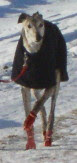
 Now, don’t make fun of my greyhound in his little fleece boots! It’s not a fashion statement, dog boots
 are a necessity in the darkest pit of the Canadian winter. Even our golden appreciates them most days.
Paw protection is especially important for the short-coated dog breeds like greyhounds, and especially when the weather is as brutal as it’s been here lately — we’re talking about -28°C, with a windchill factor that makes it feel like -40°C (that’s the same as 40 degrees below zero Fahrenheit, for my American friends). The snow squeaks when you walk on it, and exposed skin can begin to freeze in less than one minute!
So, my latest sewing project has been to sew up some new polar-fleece dog boots. These are quick to make and easy to put on the dog, but they don’t shake off very easily. I’ve made these boots with non-slid vinyl soles, elastic at the ankles, and Velcro fasteners, and the dogs don’t hate them too much.
I based this pattern on an old set of store-bought dog boots that I borrowed from a neighbour, and used some scraps of fleece, elastic, and Velcro that were left over from other sewing projects.
Feel free to use my pattern to make your own dog boots — just right-click to save the image to your computer.


It’s not very fancy, because I just sketched it out on a piece of scrap paper and then did over in a simple Paint program, but it works just fine!
And you can size the pattern up or down on your printer, to fit the size of your dog’s paws.
For the large male greyhound, I printed out my pattern so that it was 4½ inches wide, measured across the sole. Those large boots fit the Golden Retriever, too, while 1½ inches was plenty wide for boots for a mutt of vaguely Beagle-Chihuahua ancestry.
Sewing Instructions:
• Place the “toe” of the pattern on a fold of fabric and cut out around the boot shape. When you unfold the fabric, you’ll have a sort of hourglass shape. Don’t sew up the sides until you’ve done the next steps!
 I love fleece fabric for dog boots because it sews up easily, keeps the paws as warm as possible, doesn’t stain too badly, and dries quickly to be ready for the next outing. For large size boots, I used ¾-inch Velcro and the same width of elastic. For smaller boots, obviously, you’d use a narrower size.
• Following the marks I’ve put on the pattern, place a circle of vinyl or other non-slip material on the sole of the boot and sew it in place.
• Sew on a piece of Velcro at the ankle position, using the softer fuzzy half, and catching a piece of elastic underneath it, as shown. The stitching for the Velcro will hold on the elastic.
• Sew the other half of the Velcro strip (the part with all the tiny hooks) securely onto the free end of the elastic. Make sure that the hooks are facing down when you’re looking at the sole of the boot.
• Finally, fold the boot in half with the right sides together (so that the vinyl sole is inside) and sew up the sides. Turn it right side out.
Because I knew that I was going to sew my dog boots from fleece fabric, which doesn’t fray or ravel, I didn’t add much of a seam allowance to the pattern — about ¼” around the edges — so you might want to count in an extra bit of width for seam allowance if you’re planning to use a woven fabric like a waterproof nylon or such. The other thing I did that’s different from the pattern is adjust the height of the boots — ankle boots are of limited use for a country dog, so I extended the tops up a little bit to better handle the snow-softened farm lanes where we like to walk.

To put the boots on the dog — just turn the boot so that the sole is to the back of the dog’s leg, and slide his paw into the boot. Wrap the elastic around the front of the leg, as shown, and fasten the Velcro. (If your dog has never worn boots before, see also How to Teach a Dog to Wear Boots.)
This lazy greyhound was napping in his crate and refused to get up to model his boots, in case I was going to make him go out in the cold, so this picture shows the view you get when a dog is lying down… but you can get the idea…
So there you have it: my pattern and instructions for sewing dog boots. Feel free to use it as you like!
Oh, and I’d love it if you could let me know if you come up with any improvements to the design. I’m thinking, for example, of making an even taller pair (with two fasteners) for when the dogs are walking in a real bit of snow…
Thank you so much for your great puppy shoes pattern! I found you about 4 years ago, right after we moved to the extreme heat of Arizona. We have sidewalks that are in excess of 120* in the summers, so your puppy shoes have been a blessing. My furbaby LOVES her shoes. I’ve made several pair, because we keep burning through the vinyl soles, but she knows when we start putting on shoes, we are going outside. We’ve gotten appreciative comments whenever we go out for walks, people thanking me for protecting her little feeties! Great pattern, great instructions, sheer inspiration!
Annette a suggestion so ya ain’t gotta keep making boots all the time. If you use a piece of leather I’m place of the nylon circle the heat won’t burn your sole out. Another thought if you find your still making lots of boots or you want more . Versatility out of your boots then instead of selling a nylon circle on there put a velcro circle on just be sure to use the hook side on the bottom of the boot and the loop side on whatever material you want to put onto the bottom of the boot because the hooks don’t wear out as fast as the loops. Anyhow that way you can make one pair of boots and do anything you wanted to with them. I’m currently in the designing phase for my two pit bulls which is how I stumbled upon this article. It’s a little chilly in Washington this year we have a foot of snow on the ground and I just hate seeing my dog pack of foot because it’s cold. Good luck
Thanks so much for this! My dog has stitches in his foot and kept getting it wet even with store bought nylon booties. So I made him a bootie out of PUL-diaper material. Works perfectly!!
Made these last weekend for my son’s spaniel to wear hiking in the mountains. I used scraps of duck canvas and lined around the inside top with flannel to keep from rubbing. Bought a pair of dollar store men’s work gloves with a rubberized textured side (palm) and cut a circle from it to make the sole to protect his paws from sharp rocks and burrs. Took him for a short hike and he loves them. Thanks for the great tutorial
Thank You So Much for this Pattern…my dog greyhound was suffering awful with this cold we have been having, and had taken to peeing in the house because her feet were hurting in this sub zero weather and socks were not working they kept coming off. My other greyhounds had never been bothered but we have never had such a long stretch of extra -10 weather either. But she loves her “Shoes” it’s like she knew they were going to help her feet right away! She was patient putting them on and took to them right away! It only took me about 40 minutes to make her a set. Thank You!!! Had some extra fleece so made her a scarf to match her coat so her shoes match her coat! :)
Can you sew this by hand or do you have to use a sewing machine?
hi there thanks for this sewing pattern going to make some for a charity the blue cross to use in their animal hospital for animals in surgery and its nice and simple for a beginner like me :) cant wait :) xx